





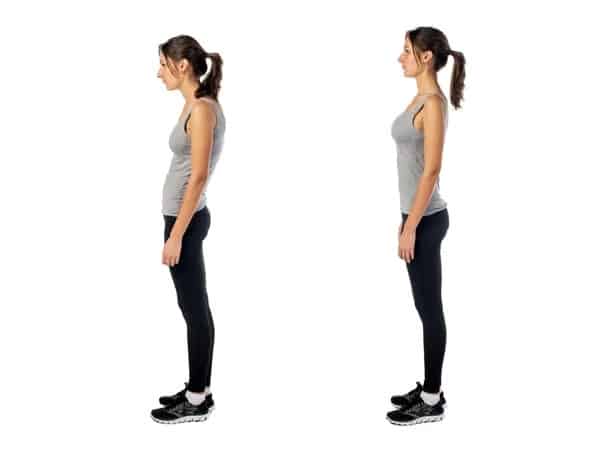

 Want to earn continuing education credit for this article? Learn more.
After giving countless massages, it is easy to fall into the habit of performing the same routine on each client. Most therapists tend to rely on a familiar work rhythm when a client does not have a particular complaint. Although many people seek massage therapy solely for relaxation, conducting a professional assessment, including postural evaluation, extends the benefits of your work beyond relaxation to target their specific needs.
A tool designed to identify structural imbalance, postural evaluation is a reliable method of customizing a treatment plan to facilitate a deeper level of healing. Since structural imbalances often underlie chronic pain and dysfunction, correcting the imbalance can be a long-term solution for chronic musculoskeletal imbalance.
Evaluating a client’s posture includes knowing what to look for and then deciphering the meaning of what you see.
What to Look For
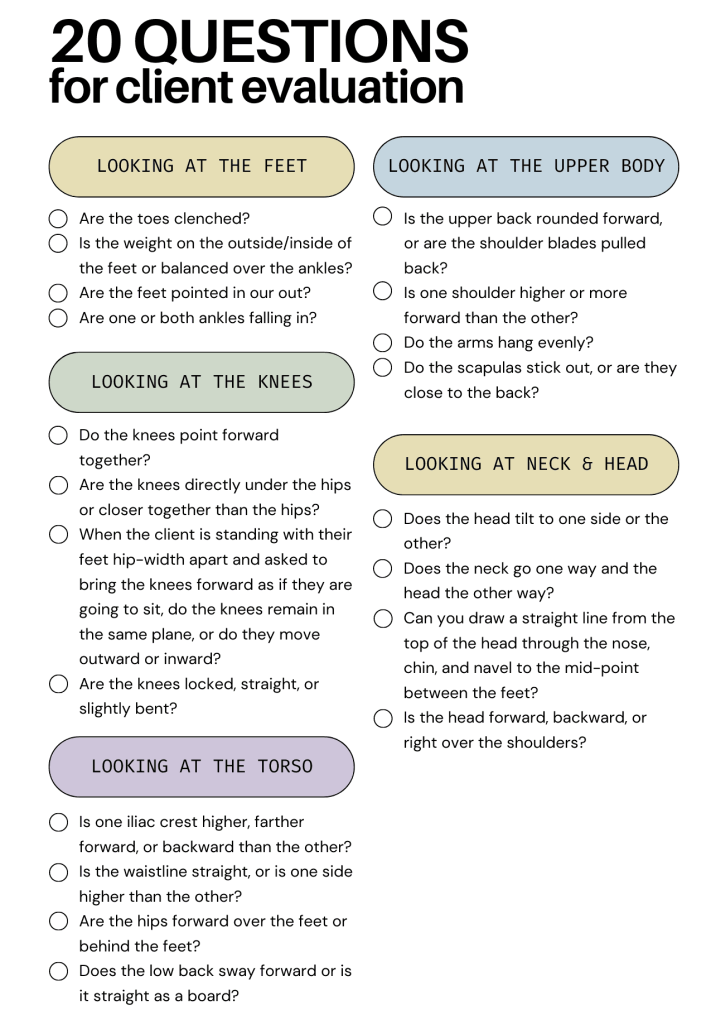
Below are 20 questions to consider when evaluating a client’s physical characteristics.
Symmetry
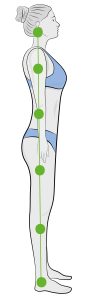 Characterized primarily by symmetry, ideal alignment is when the feet are directly under the hips and knees. At the same time, the torso, shoulders, and neck are balanced over the hips with minimal muscular activity to hold this upright position. The knees and feet should point straight ahead, and the client’s weight should be symmetrically balanced over the feet. From the side, you should be able to draw a line perpendicular to the floor straight through the ear, shoulder, hip, and ankle. Indicative of misalignment, any deviance from symmetry represents either a current or eventual problem.
The Next Step
Once a postural deviation from normal is identified, the next step is identifying the muscles involved. A working knowledge of anatomy will make this an easy task. Remember that misalignment leads to more stress in certain body areas, just as when a car’s tires need balancing. Certain areas will incur greater stress and wear out faster, especially under stress or trauma.
Some examples of causes of imbalances:
- A shoulder that is lower indicates pectoralis minor/latissimus contraction.
- A high shoulder indicates trapezius and/or serratus anterior tension.
- If a shoulder is lower and forward, it indicates the pectoralis minor is the main factor.
- If the one shoulder is forward, but neither shoulder is superior to their other, or the forward shoulder is superior to the other, then the serratus anterior will be the main cause of the forward shoulder. This is because the pectoralis minor also pulls the shoulder inferior, while the serratus anterior does not.
- Head forward posture imbalance can be caused by weakened longus colli, longus capitis, infrahyoid and suprahyoid, rhomboids, serratus anterior, posterior rotator cuff, lower trapezius and tightened suboccipitals, sternocleidomastoid, upper trapezius, pectralis minor and major, levator scapula, subscapularis, and lattissimus dorsi.
- In posterior hip rotation the hamstrings, gluteus maximum and rectus abdominis will be tight.
- In an anterior hip rotation the rectus femoris and iliopsoas on the front and the erectors on the back will be tight.
- Anterior pelvic tilt (lordosis) may include all or part of the following: weak anterior abdominal muscle, tight hip flexor muscles (chiefly iliopsoas), tight low back muscles and weak hip extensor muscles.
After identifying the misalignment, the massage therapist must determine which muscles are abnormally stretched and which are shortened before choosing the most effective techniques to correct the imbalance. Neuromuscular therapy is one such massage technique traditionally used to restore balance to the musculoskeletal system.
Identifying the Cause of a Postural Imbalance
When applied correctly, massage techniques can restore a client’s ideal alignment. While this is good news for bodyworkers, one more step must be taken – figuring out how the problem started. Detective work is often needed to determine where the poor posture originated from. Since the way we carry ourselves is a culmination of our experiences, emotions, traumas, strengths, and weaknesses, a practitioner must typically recruit the client’s help to identify the cause of a postural imbalance.
A typical cause of bad posture is tense muscles, pulling the body out of alignment. In general, being conscious of maintaining proper posture and finding a way to release stress will help many people maintain their realignment. However, a lifestyle or ergonomic adjustment, such as changing from a purse to a backpack, or sitting in a chair of proper height, may be necessary.
Postural evaluation is an extremely valuable skill for any massage therapist to have. For bodyworkers striving to break beyond the limits of “relaxation only” to provide therapeutic and individualized massage sessions, learning to perform and utilize postural evaluation will help bring their practice to the next level.
Earn continuing education credit for this article contained in our Low Back Pain series. Click here to enroll.





 Follow Us